×

The Standard e-Paper
Join Thousands of Readers





Audio By Vocalize
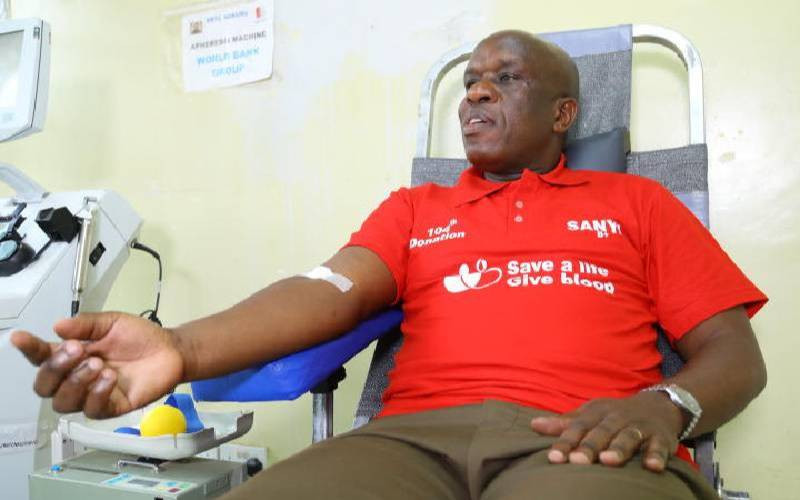
Alpha Kennedy Sanya, the highest blood donor in Kenya, donates blood at the Kenya National Blood Transfusion Services in Nakuru. [File, Standard]
For Alpha Kennedy Sanya, donating blood has become a lifelong mission. He has done it 111 times — more than anyone else in Kenya — and is still counting.
The country’s highest blood donor is tirelessly rallying friends, community, church congregants, police officers and court officials to donate blood in pursuit of a mission he says only death will stop.
Sanya says his goal is saving lives and that he feels fulfilled knowing patients in need of life-saving blood transfusions are able to access them.
“Most Kenyans fear the prick of a needle, but can that pain be compared to the pain of losing a loved one simply because blood was unavailable when they needed it?” asks Sanya.
“It satisfies my heart to see patients wheeled into the theatre and come out safely because blood was available. It brings me untold joy to see a mother cuddle her baby after childbirth, having survived excessive bleeding because someone donated just a pint of blood, and a life was saved. This is what humanity dictates,” adds Sanya.
As Kenya joined the rest of the world in commemorating World Blood Donor Day on June 14, Sanya stood out as a decorated hero.
The Nakuru-based court prosecutor has emerged as the country’s most prolific blood donor, a duty he carries out wholeheartedly.
“Every time I donate blood, I make a covenant with God to grant me good health and life so that I can come back and donate an extra pint again and again. I donate blood as a way of giving back to society,” says Sanya.
Beyond donating, Sanya mobilises other people to the noble cause through phone calls, word of mouth and social media.
Whenever there is a shortage, he reaches out to trusted regular voluntary donors and encourages them to give blood, helping maintain a steady supply in blood banks in the Rift Valley region and across the country.
The Standard meets him at the Nakuru Anglican Church of Kenya cathedral, addressing congregants on the need to donate blood.
After the service, worshippers stream into a tent outside the church to donate blood in an exercise coordinated by the Kenya National Blood Transfusion Service (KNBTS), Rift Valley region.
The drive is conducted during all three church services, at 7 am, 9 am and 11.30 am.
During the drive, KNBTS officials encouraged more people to become regular blood donors.
The church, through the bishop’s office, hosts a blood donation drive at least once every three months.
“Donating blood is one of the noblest forms of giving because it saves lives. It is a practice we should all embrace,” says Sanya.
At his workplace, he regularly mobilises police officers, prosecutors and court officials to donate blood.
His campaigns have successfully attracted many first-time donors, particularly people in their 30s and 40s. The efforts have also helped retain regular donors.
The commitment to saving lives has earned him not only self-satisfaction but also national recognition.
Former President Uhuru Kenyatta awarded him the Head of State Commendation (HSC), while President William Ruto honoured him with a Shujaa Award during Mashujaa Day celebrations in 2024.
“The awards filled my heart with joy. Although this was a personal commitment between God and me, it was encouraging to see others recognise the impact. It motivates me even more,” he says. “It was great being invited by the government to attend Mashujaa as a guest of the State”.
Sanya urges all eligible Kenyans to donate blood regularly.
“Blood donation is allowed every three months. If it were possible to donate daily, I would do it,” he says.
Sanya’s journey began when he was in Form Three at Pumwani Boys High School in Nairobi. Like many students, he was drawn by the bread and soda offered after donation.
However, his commitment deepened after the August 7, 1998, bombing of the US Embassy in Nairobi. The tragedy left hundreds dead and thousands injured, creating an urgent need for blood.
“It really disturbed me that Kenya had to import blood from South Africa and Israel to save lives,” he recalls. “I was heartbroken by the desperation of those who needed blood. I kept wondering: Did they survive? Did they die?”
Data shows that about 10 Kenyans require blood transfusions every 10 minutes. Those in need include accident victims, mothers experiencing complications during childbirth and patients undergoing surgery.
Kenya requires 500,000 pints of blood annually to meet demand, but collections often fall short, averaging between 300,000 and 400,000 pints.
To boost blood donation, Kenya appointed four National Blood Donation Ambassadors in 2024 — Sanya, Caroline Wang’amati of the Coalition of Blood for Africa, Charlene Ruto and Asha Daffala, the country’s leading female blood donor.
As patron of the Kenyan by Blood Foundation, Charlene has championed blood donation among the youth through campaigns in universities, colleges and schools.
Her campaign seeks to ensure blood is available for emergencies. “Blood donation is one of the causes I champion from the heart,” she said in a previous media interview.
According to KNBTS, volunteer blood donors remain the backbone of the country’s blood supply system.
Subscribe to our newsletter and stay updated on the latest developments and special offers!